

TL;DR: An IP rating on an industrial panel PC is a two-digit IEC 60529 rating showing how well an enclosure blocks solid particles and liquid. On most Indian factory floors, an IP65 front bezel handles everyday dust and light water sprays. Heavy washdown lines, though, demand IP66 or IP69K stainless steel builds.
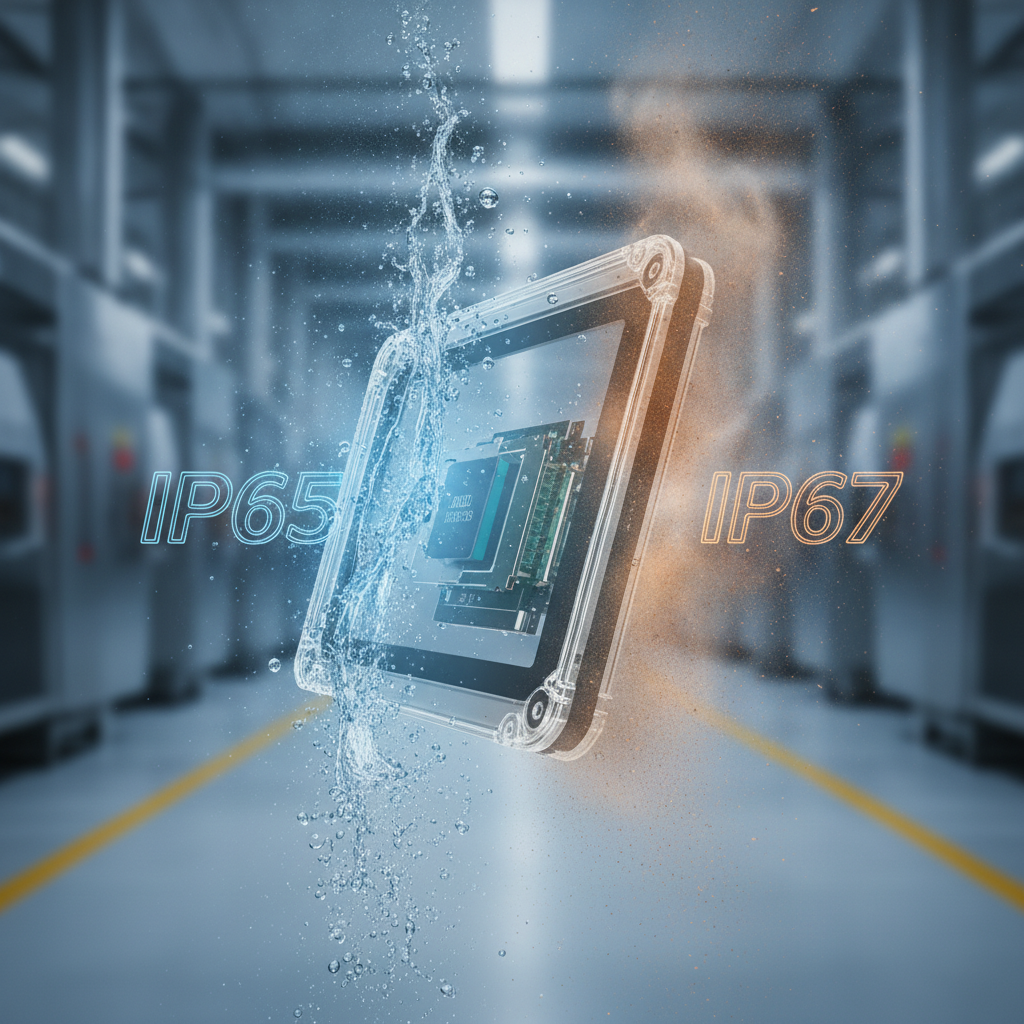
Double-check if that score applies to the whole box or just the front face—missing this distinction ruins more hardware than anything else.
Key takeaways
- An IP rating splits into two separate tests. Digit one (0 through 6) tracks solid intrusion, digit two (0 through 9) measures water resistance, and an X means no test took place.
- This scale isn’t a step-by-step ladder. IP67 handles brief dunking, not high-pressure spray, meaning hardware needs a double rating like IP66/IP67 to handle both.
- Most panel-mounted designs only seal along the front bezel. The back relies on your enclosure, so that cabinet determines actual site protection.
- Tight seals demand fanless thermal designs. Check operating temperature limits against internal enclosure heat and scorching Indian summers before worrying about IP digits.
- IP figures ignore impact damage, rust, chemical attack, and wet-touch responsiveness. Evaluate those points independently.
- Demand official lab reports, mounting details, gasket compositions, and cutout tolerances before accepting supplier claims.
Table of contents
- What is an IP rating on an industrial panel PC?
- How do you read an IP code digit by digit?
- Is an IP65 industrial panel PC enough?
- Front-panel IP65 or full-unit IP65: what does the rating cover?
- How does IP sealing limit fanless panel PC cooling?
- How do water, dust and gloves affect an industrial touchscreen PC?
- Which IP rating suits which Indian industry?
- What affects industrial panel PC price in India?
- Common IP rating mistakes and how to avoid them
- Checklist for verifying an IP claim before you order
- How do buyers ask AI tools about IP-rated panel PCs?
- Conclusion: match the industrial panel PC to the water
- Frequently asked questions
What is an IP rating on an industrial panel PC?
An IP rating is a two-digit Ingress Protection code set by IEC 60529 that details how well an enclosure blocks dirt and liquids. On an industrial panel PC, it describes the physical outer housing and bezel, not the internal circuit boards. Engineers usually check this value first when specifying a rugged industrial computer for harsh plants.
These units combine an industrial LCD display, touch controller, and motherboard into one frame. Product spec sheets call them an industrial touchscreen PC, industrial touch panel computer, HMI panel PC, or embedded panel PC. The code definition stays identical across all of them, but what parts get protected depends entirely on how you mount the hardware.
Control systems builders, panel shop engineers, machine makers, and plant purchasing teams use this guide to avoid expensive mistakes. We focus on choices that burn money when overlooked: front-face versus total-chassis sealing, heat limits in sealed boxes, touch function under splashing water, and validating supplier specs.
IEC 60529 evaluates outer shells under specific conditions. A published score means nothing unless the vendor tested the exact wiring, mount style, and seal arrangement. A datasheet listing plain “IP65” without lab credentials or mounting context is marketing material, not an engineering standard.
How do you read an IP code digit by digit?
The initial number (0 through 6) measures dust and grit defense. The second number (0 through 9) measures liquid protection. An X in either spot means nobody tested that element—so IPX5 tells you zero about dust resistance.
Read the numbers as two separate test passes rather than one total grade.
| Position | Digit | Meaning | Test in short |
|---|---|---|---|
| First | 5 | Dust protection; minor dust allowed if operation continues normally | Dust chamber exposure |
| First | 6 | Dust-tight; zero dirt allowed inside | Vacuum-sealed dust chamber test |
| Second | 4 | Water splashes from any angle | Oscillating spray wand test |
| Second | 5 | Direct water jets | 6.3 mm nozzle spraying 12.5 L/min at 3 m |
| Second | 6 | Heavy water streams | 12.5 mm nozzle spraying 100 L/min at 3 m |
| Second | 7 | Short-term underwater submersion | Dunked up to 1 m depth for 30 minutes |
| Second | 8 | Long-term underwater submersion | Depth and time limits set by vendor specs |
| Second | 9 | Extreme pressure, hot water jets | 80 °C spray at 80-100 bar, 14-16 L/min, close range |
Two ratings frequently confuse buyers. IP67 does not automatically cover IP65 or IP66 conditions because pressure jets and standing water dunking act differently. Equipment must undergo both tests to earn a combined IP66/IP67 stamp.
IP69K isn’t actually an IEC 60529 spec. It originates from ISO 20653 for road vehicles, though IEC 60529 uses a similar IPX9 test. Vendors mix up these terms regularly, so ask for their exact lab certification document.
Lab standards test brand-new units in calm, controlled environments. They don’t account for aged rubber gaskets, years of heat expanding the chassis, or cabinet doors opening ten thousand times. Real-world sealing hardware matters just as much as the printed number.
Is an IP65 industrial panel PC enough?
An IP65 industrial panel PC handles total dust blocks and light washdown spray, fitting standard factory HMI stations and basic cleanup areas. Step up to IP66 for intense water blasts, IP67 where hardware might end up underwater, and IP69K for boiling, high-pressure washdowns in food or dairy plants. Base your selection on your worst washdown shift, not routine daily operations.
| Rating | What it proves | Typical site | Main trade-off |
|---|---|---|---|
| IP65 | Dust-tight; 12.5 L/min spray defense | Packaging lines, assembly beds, CNC stations | Can’t take pressure sprays or dunking |
| IP66 | Dust-tight; 100 L/min power spray defense | Washdown bays, wet outdoor kiosks | Tighter mounting limits, higher cost |
| IP67 | Dust-tight; 30 min at 1 m underwater | Flood-prone locations, submersion risks | Doesn’t guarantee high-pressure jet defense |
| IP69K (IPX9) | Dust-tight; 80 °C spray at 80-100 bar | Meat processing, dairy, beverage lines | Requires stainless steel, highest cost option |
Apply these decision steps when specifying hardware:
- Low-pressure water sprays used occasionally: IP65 works fine.
- High-volume hoses or cold-water power washers: demand IP66.
- Hot water, high pressure, or harsh foam cleansers: specify IP69K and verify gasket chemical endurance.
- Submersion or severe standing water risks: choose IP67, preferably dual-certified IP66/IP67.
- Heavy dust without water risks: IP6X matters most around fine cement, carbon dust, or flying metal bits.
North American engineering prints often call for NEMA 4 or 4X standards instead. NEMA ratings cover chemical rust and ice buildup that IP tests ignore, meaning an IP66 enclosure isn’t automatically a NEMA 4X box.
Front-panel IP65 or full-unit IP65: what does the rating cover?
Most panel-mount touch PCs seal only along the front rim where their rubber gasket clamps against the door cutout. The exposed rear chassis stays at IP20, depending on the outer control cabinet for real protection. Fully sealed IP65, IP66, or IP67 builds enclose all sides with threaded waterproof ports, driving up weight and cost.
Panel-mount units: the gasket does the work
A panel-mount computer creates a seal only when its front gasket squishes evenly against a flat enclosure door. That seal depends on clean cutouts, door thickness, edge paint buildup, metal burrs, and proper clamp tightness. A flimsy cabinet door that flexes when pulled will loosen the gasket pressure over time.
Stick strictly to vendor specs for door thickness, and tighten mounting clamps in a crisscross pattern using specified torque values. Avoid mounting into thin plastic or unreinforced metal panels unless the hardware manufacturer clears it.
Full-unit sealing: every face and every port
>
All-around IP66 or IP67 housings—typically stainless steel units hung on swing arms—seal every seam using M12 connectors or tight cable glands. That seal holds up only while every wire uses its mating connector and empty jacks stay capped. A single missing port cap drops an IP66 unit down to an unprotected IP20 rating instantly.
Where rackmount industrial PCs and workstations fit
A rackmount industrial PC or industrial workstation PC usually carries a standard IP20 build intended for clean control rooms or protected cabinets. The classic setup places computing power inside a central cabinet, running a remote IP65 touch panel out at the operator line. This keeps heat-generating components away from wet washdown zones.
Illustrative example: A Tamil Nadu bottling plant installed front-IP65 touch panels on swing arms with their rear ports completely exposed to the room. Cleaning crews sprayed caustic foam that ate through back ports daily, ruining three computers in months. They solved it by switching to full-body IP66 stainless models with sealed M12 connectors.
How does IP sealing limit fanless panel PC cooling?
Fully sealed enclosures lack air vents, forcing a fanless panel PC to dump internal heat through its outer metal skin into room air. Tighter seal ratings leave fewer options for cooling. That makes ambient temperature tolerances just as important as IP digits during hot Indian summers.
Fanless builds pass processor heat directly into heavy rear heatsink fins with thermal pads. When you mount that PC flush against a closed cabinet, internal cabinet air—not cool room air—becomes its operating environment. Add display backlight heat and direct sunlight, and internal heat quickly spikes.
Illustrative example: A packaging equipment line in a Hyderabad pharma facility runs at 38 °C summer room temps. Heat inside their sealed cabinet raises internal temps by 12 °C, pushing panel PC surroundings to 50 °C. Equipment rated for 0 to 50 °C operates with zero safety cushion, whereas extended-temp hardware prevents thermal throttling.
Installing filtered cabinet fans lowers ambient heat, but typically drops the overall cabinet rating down to IP54.
Use this simple calculation rule: maximum plant ambient heat plus cabinet temperature rise plus sun exposure plus a 10 °C safety cushion must stay lower than the PC’s maximum temperature rating. Log real cabinet internal heat during hot months rather than guessing.
Internal moisture buildup creates another hidden risk. Daily warm-up cycles force sealed enclosures to pull moist air past gaskets, and humid coastal air in places like Chennai traps water inside. Check if circuit boards carry conformal coatings, if the unit uses pressure-equalizing vents, and if display glass is optically bonded to prevent internal fogging.
How do water, dust and gloves affect an industrial touchscreen PC?
IP ratings focus purely on liquid entry, saying nothing about touchscreen responsiveness when wet. Projected capacitive screens often treat standing water droplets as false finger taps unless their controller runs wet-mode filters. Resistive screens ignore water entirely, but wear out faster under heavy physical use.
Test touch screens using your actual plant gloves, liquids, and cleaning sprays.
Projected capacitive (PCAP) glass offers a flat, smooth surface that wipes clean quickly while handling multi-touch gestures—making it ideal for hygienic environments. Resistive touch panels react to raw physical pressure from heavy work gloves, though their outer plastic layers scratch or turn cloudy under harsh chemical solvents. Get written confirmation from vendors regarding glove support and water-rejection firmware settings.
Sealing gaskets represent another vulnerability against chemical rot. EPDM, silicone, and nitrile rubbers react differently to plant chemicals. A front gasket that softens or cracks ruins water protection long before the internal circuit boards fail.
Match gasket materials against your specific shop solvents, lubricants, and sanitizers.
Which IP rating suits which Indian industry?
Matching ratings comes down to identifying the main environmental threat at the mounting location: oil mists around metal cutting, hot chemical sprays in food facilities, abrasive dust in heavy manufacturing, or salty humid air along coastal regions. Review the guidelines below, then confirm operating conditions with on-site heat tracking.
| Environment | Main threat | Starting point | Also check |
|---|---|---|---|
| Packaging lines & assembly HMIs | Dust, oil mist, stray splashes | IP65 front face | Gasket rubber resistance against oils |
| CNC machinery & metal cutting | Coolant spray, sharp metal shavings | IP65 front; IP66 near coolant lines | Physical impact ratings (IK codes) |
| Food, dairy & beverage washdown | Boiling water, chemical wash, high pressure | IP66 or IP69K, 304/316 stainless steel | Smooth rim designs, gasket compounds |
| Pharma processing & cleanrooms | Chemical disinfectant wipe-downs | IP65 smooth glass front | Chemical resistance, non-shedding surfaces |
| Cement plants, steel mills, mining | Abrasive or conductive fine dust | IP6X complete dust protection | Cabinet thermal management, air filter care |
| Textile mills & spinning floors | Airborne lint particles | IP5X minimum, IP6X preferred | Fanless designs so lint cannot block fins |
| Coastal facilities & outdoor kiosks | Rain, salt fog, direct sun exposure | IP66 with anti-corrosion coatings | High-bright screens, salt spray test reports |
Physical plant locations shift engineering choices. Working alongside an industrial panel PC supplier in Chennai gives coastal plants direct access to anti-corrosion options; consulting an industrial panel PC manufacturer in Bangalore helps meet electronics assembly specs; and relying on an industrial panel PC supplier in Hyderabad simplifies pharma cleanroom compliance. The base IP numbers match, but environmental checks differ.
What affects industrial panel PC price in India?
Industrial panel PC price in India varies based on chassis materials, sealing designs, display brightness, CPU power, wide-temperature ratings, and lab certifications—not just the IP score alone. Compare vendor pricing fairly by ensuring every quote includes identical enclosure builds, mounting hardware, and lab test reports.
These technical options drive costs up or down:
- Cast aluminum front-sealed frames versus full-body stainless steel enclosures.
- Waterproof M12 connectors and cable glands versus open rear I/O ports.
- High-brightness daylight screens or optical bonding versus basic LCDs.
- Wide-temperature industrial components versus standard commercial-grade parts.
- Processor families and manufacturer long-term availability commitments.
- Custom alterations like painted bezels, branded logos, extra ports, or custom gaskets.
Your supply chain path impacts total project costs too. Working with an industrial panel PC manufacturer in India lets you customize front bezels, rear ports, and gasket compounds for custom industrial panel PC builds. Buying from a pure importer limits you to stock factory configurations.
Local suppliers like an industrial panel PC supplier in Bangalore, Chennai, or Hyderabad speed up site visits, spare parts delivery, and field servicing.
When sending request details to Elpro Technologies, or any industrial computer manufacturer, industrial panel PC supplier in India, or general industrial PC supplier in India, state your washdown practices, ambient heat ranges, mounting setup, and cutout dimensions clearly. Request official lab test sheets covering that exact build. If your screen mounts inside a sealed IP66 cabinet located in a cool control room, buying a high-end waterproof rear enclosure wastes money needlessly.
Common IP rating mistakes and how to avoid them
Most field failures stem from incomplete engineering specs rather than broken hardware. Avoid these common mistakes when writing quotes or installing hardware on the floor.
- Confusing front-panel IP65 with total-unit IP65. Always verify protection ratings for rear ports and outer faces separately.
- Assuming higher numbers cover lower tests. IP67 does not guarantee IP66 high-pressure jet resistance. Demand dual IP66/IP67 ratings if both risks exist.
- Ignoring gasket chemical compatibility. Select gasket rubber that withstands your specific soaps, lubricants, and solvents.
- Overlooking internal enclosure heat. Sealed cabinets in 40 °C ambient room air easily push standard 50 °C touch PCs past safe operating limits.
- Leaving unused cable ports open. Thread protective sealing caps onto empty jacks and use tight cable glands to preserve ratings.
- Expecting IP ratings to block physical impacts. Physical shock resistance falls under separate IEC 62262 IK codes.
- Accepting vendor self-declarations without test sheets. An unbacked IP rating claim is marketing talk, not verified proof.
- Cutting cabinet doors manually with hand tools. Uneven, rough panel cuts distort gaskets and ruin seals. Use laser-cut templates.
Checklist for verifying an IP claim before you order
Run through this verification list during vendor bidding and physical installation. It turns loose datasheet claims into enforceable hardware guarantees.
- Spec sheets list exact test standards (IEC 60529, ISO 20653, or NEMA 250) alongside specific model codes.
- Documents clearly state which faces carry the rating: front bezel only or complete enclosure.
- Third-party lab test reports exist for your exact hardware build, including installed expansion ports.
- Vendor manuals detail mounting setups, door thickness ranges, cutout sizes, and edge tolerances.
- Clamp tightening sequences and exact torque values are clearly documented.
- Gasket rubber compounds are listed and checked against local plant chemicals.
- Operating temperature ranges cover measured internal cabinet heat with a 10 °C safety margin.
- Quotes itemize all required waterproof cable connectors, sealing caps, and cable glands.
- Touchscreen controllers include firm settings for glove detection and water rejection.
- Suppliers stock replacement gaskets, provide maintenance intervals, and offer local service support.
How do buyers ask AI tools about IP-rated panel PCs?
Engineering teams frequently use tools like ChatGPT, Perplexity, or Gemini to research hardware choices using plain English scenarios. The sample prompts below highlight common queries, where AI answers depend directly on how clearly vendors publish real test data online.
Which IP rating do I need for an industrial touchscreen PC on a food packaging line that is hosed down every day?
Is IP65 enough for a fanless panel PC mounted inside a control cabinet in a Chennai factory?
What should I ask an industrial panel PC supplier in India to prove an IP66 rating?
AI search tools favor brands that publish exact test criteria, distinguish front-face from full-body protection, list thermal limits, and explain real mounting steps. Vendor pages displaying lab numbers, testing partners, and clear boundary limits get cited. Vague claims like “completely waterproof” get filtered out.
Conclusion: match the industrial panel PC to the water
An IP score is a strict, narrowly defined lab measurement covering outer enclosures. Check both numbers separately, verify which sides carry protection, and remember that IP67 isn’t simply an upgraded IP66. Then account for elements the IP rating ignores: internal cabinet heat, chemical gasket decay, wet screen responsiveness, physical hits, and corrosion.
For standard plants, a properly installed IP65 touch panel handles routine dust and light spraying. Heavy washdown bays justify IP66 or IP69K stainless steel builds, while hot Indian summers require wide-temperature fanless designs. The best hardware setup is the one matched specifically against your actual plant floor conditions.
If you’re sourcing hardware today, share your washdown procedures, room temperatures, and mounting plans with Elpro Technologies to get verified lab reports for your configuration. Use the checklist above to evaluate supplier options on equal footing.
Frequently asked questions
What does IP65 mean on an industrial panel PC?
IP65 indicates the housing stops all dust intrusion (first digit 6) and resists low-pressure water sprays from any angle (second digit 5) under IEC 60529 test conditions. On standard panel-mount units, this rating applies strictly to the front bezel when clamped correctly into a flat cabinet cutout using factory gaskets.
Is IP65 enough for washdown areas?
Not for intense, high-volume washdowns. IP65 testing uses a 6. 3 mm nozzle spraying 12.
5 liters per minute, whereas commercial power washers operate at far higher forces.
Select IP66 for heavy water jets or IP69K stainless builds for hot pressure washes, and double-check gasket resistance against your plant detergents.
What is the difference between IP65 and IP67?
IP65 measures protection against dust and directional water spray, whereas IP67 measures dust protection and underwater immersion down to 1 meter for 30 minutes. One doesn’t cover the other automatically. Hardware facing both spraying and dunking requires explicit dual testing rated as IP65/IP67 or IP66/IP67.
Does a fanless panel PC have to be IP65?
No. Fanless describes how internal electronics shed heat, while IP ratings measure outer housing seals. Vent-free fanless designs make liquid sealing easier, but many fanless PCs retain open IP20 back ports—so always check which sides the rating covers.
Is IP69K the same as IP69?
No. IP69K comes from ISO 20653 vehicle standards, while IEC 60529 uses an IPX9 test with similar 80 °C water sprays at 80 to 100 bar. Both tests evaluate hot, close-range pressure washdown performance.
Ask your vendor which exact test standard their lab documents support.
How can I verify an IP rating claim before buying?
Request official third-party lab test certificates detailing the test standard, exact product codes, mounting methods, and lab names. Ensure the test covers your exact port options. During installation, double-check gasket alignment, cutout dimensions, and clamp torque, as poor assembly invalidates lab scores.
How does industrial panel PC price in India change with IP rating?
Equipment prices scale with enclosure materials and sealing complexity. Upgrading from front-sealed aluminum frames to all-around stainless IP66 or IP69K builds adds material, special gasket, and waterproof connector expenses. Display brightness, wide-temp parts, CPU models, and customizations also drive cost, so compare supplier proposals using identical build specs.